Tuesday, April 20, 2010

Crafting the "Temple of Healing"


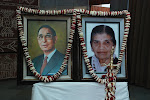
Like most great institutions, the Santokba Durlabhji hospital had a very modest start over 4 decades ago. The year was 1963 when, during an evening stroll, Dr. Tarachand Gangwal proposed to Shri Khailshanker Durlabhji – ‘Khelu Bhai’, as he was endearingly called - that a diagnostic clinic be started on a “no profit, no loss basis”. The clinic began without any hype or fanfare in a small corner of the Modi Dharamshala, opposite SMS Hospital. It became an instant success. The State Government recognized the potential of this highly useful public utility undertaking, and further strengthened it by lending to it the services of its medical experts. This encouraged the Founder to start a Maternity cum Nursing Home in C-Scheme in 1968.

The successful foray into the hitherto unexplored private sector further emboldened Khelubhai. Being a visionary in mind, and a missionary at heart, he embarked upon a bigger and more ambitious venture - the present-day Santokba Durlabhji Memorial Hospital cum Medical Research Institute. SDMH was inaugurated by Smt. Indra Gandhi, the then Prime Minister of India, on 29th November, 1971. Khelu Bhai’s dream of perpetuating the memory of his revered father by building a “Temple of Healing” for the sick and the needy became reality.

Right from inception, the hospital, with its modest bed strength of 80 beds and only 6 specialities, was imbued with the noble spirit of providing state-of-the-art health care at affordable rates through a strong commitment for excellence. In fact, the Santokba Durlabhji Trust, which managed the hospital, epitomized excellence, and firmly believed in rendering the "best service at minimal cost”. That is why, even after 39 years, the expenditure still exceeds the income from the patients. Further, no patient is ever denied treatment because he is too poor to pay.

Over the years, the span and scope of the hospital have undergone a metamorphosis, a huge sea-change. Specialties and super-specialities have been extended and expanded, with multiple procedures, surgeries and facilities - all under one roof.

Some milestones include:

1. A very well-equipped Blood Bank with NAT test facility.

2. A Computer Centre for supporting and co-ordinating multifarious hospital activities.

3. A spacious “atithigrah”, where relatives of indoor patients stay for a token payment.

4. A Physiotherapy Department ranked among the top centres of the country.

5. An on-line library.

6. A NABL accreditation diagnostic lab which is considered to be the Mecca of histopathology in Rajasthan.

7. Avedna Ashram: It is a hospice for terminally ill patients. Here the health-care staff works sincerely and patiently “to add life to a person’s days, when medicines cannot add days to his life”. The Ashram was described by the Hon’ble A P J Abdul Kalam as the “Work of God – this institution of kindness”.

8. An outreach programme where we tend to the people, the world tends to forget.

In addition, the hospital has become part and parcel of academia. It is recognized for post-graduate training by the University of Rajasthan, the Medical Council of India and the National Board of Examination.


It conclusion, it is to be emphasized that although exponential growth in medical amenities, facilities and services has occurred in record time, the trustees have never deviated from the basic tenets and essential philosophy of the Founder - namely, to blend the sophisitication and scope of services of the new millennium medical centre with the compassion, empathy and warmth of a community hospital.

Yogendra Durlabhji

Monday, April 19, 2010

SERVICE TO HUMANITY


Empathy is the word that immediately comes to mind as I think of my father. Empathy is aptly defined as someone else’s pain in your heart. My father felt the pain of many in his.


He was deeply affected by the plight of the pavement dwellers he drove past on his way to work – he would cover them with blankets during clandestine outings at night.


That shared pain for those who dwelt on pavements and lived on the periphery of life was evident at the hospital we know as Santokba. Santokba is the story of his vision which impacted a million lives. It is the story of the love and dedication of a family that, for almost 40 years now, has made Rajasthan a healthier place to live in. It is the story of nurses, technicians and doctors, of carpenters and electricians, of patients, attendants and residents. It is not about martyrdom or about sacrifice but about care, compassion and concern.


Khelubhai, or Khailshanker ji, conceptualized Santokba in the 60s in the course of his daily walkathons with Dr. Tarachand ji Gangwal.

Smt Indira Gandhi, then Prime Minister, inaugurated the hospital in 1971. My brother, Rashmi, translated my father’s dream into cement and glass, IV drips and syringes, residents and rooms.


The family has carried on manfully – despite constraints, and disregarding handicaps. It has overcome challenges and hurdles, and it has done so with panache. It is a loving legacy that Pappa handed over to caring hands. For him, the hospital was the summun bonum of his very existence. He lived for the hospital, and the hospital lived in him. It filled his hours and days. Lovingly, he felt for the patients admitted there, and for their attendants. He was sensitive to their every need, sympathetic to their every requirement, responsive to their every problem.


We strive to carry the torch forward in this same spirit of joy and understanding. As we so fondly remember Pappa, we dedicate ourselves to creating the Santokba he always visualized.


Santokba was the true happiness that he may have missed out on at work. It was his life, quite literally. So is it ours.


Yogi Durlabhji